
By Emily Gillo, PhD, University of Memphis
My hometown of Memphis, TN is a landmark city for the Civil Rights Movement, the birthplace of the blues and rock n’ roll, and the best city in the world for BBQ (unbiased opinion). But in recent years, Memphis has garnered a reputation for being “the most dangerous city in the country” and the city with the highest violent crime rate in the state of Tennessee. This is despite the fact that Memphis’s crime rates – particularly violent crime – have been on a steady decrease since 2021. That didn’t stop city leaders from forming the Memphis Safe Task force in September 2025 following the Trump administration’s “Restoring Law and Order in Memphis” Executive Order, sending the National Guard and Immigration and Customs Enforcement who, despite the lack of national news coverage, are still very present in our community to this day. Aside from the continued presence of ICE and the National Guard alongside a massive increase in Tennessee State Troopers patrolling Memphis, we have also seen a huge uptick in the number of Flock cameras around the city.
Flock describes itself as a public safety technology company that combines video and gunshot detection capabilities to work with law enforcement to support safer communities. For a far more technical overview of what Flock is and does, I highly recommend checking out Benn Jordan’s YouTube channel, but essentially Flock cameras are ALPR – Automatic License Plate Recognition – cameras that are installed around the city, complete with their own solar panel, and spend their days scanning license plates of passers-by. These ALPR cameras have the capability to capture and log descriptive features of passing cars, including color, make/model, bumper stickers, etc. Flock’s website states that law enforcement receives real-time alerts on flagged vehicles, that their cameras can provide clear and searchable vehicle data, and that they are “built for secure, responsible use with custom permissions, usage audits, and limited data retention” (despite the fact that Benn Jordan has demonstrated that these devices can be hacked in mere minutes). They have also allowed a police officer in Milwaukee to stalk his ex-girlfriend for months, and they frequently misidentify vehicle information, leading to innocent people being jailed, held at gunpoint, and charged with crimes they did not commit.
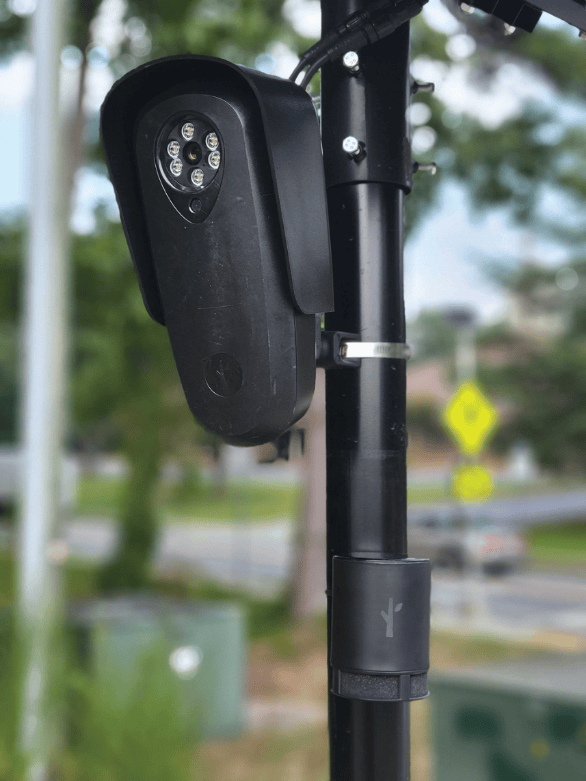
Caption: a standard ALPR (license plate reader) Flock camera that has a fixed-point camera lens circled by infrared LED lights and a motion sensor.
Flock x Campus Police
According to Flock’s Transparency Portal for Shelby County, TN, there are currently 178 Flock cameras, and at the time of writing, 935,397 unique license plates have been read in the past 30 days. The list of organizations that have access to Shelby County, TN data is incredibly long, but at the top of the list is the Federal Bureau of Investigation. In a Flock blog post about Memphis, Lt. David Ballard appeals to the age-old fallacy about surveillance that if you have nothing to hide, you have nothing to fear, stating “These cameras aren’t out there tracking your movement, they’re tracking bad guys. We don’t care that you’re coming home, we don’t care that you’re coming to work. We can’t look at that.” Remember the Milwaukee police officer who stalked his ex-girlfriend’s movements for months? You can look at that.
The University of Memphis has been facing its own issues with crimes that technically border official campus lines. My building sits on the city/campus border, and has been put on lockdown multiple times due to active shooters over the past few years. Despite many of us requesting additional human security officers to be stationed near our building, what we received instead is Flock – two ALPRs on opposite ends of campus and several others around the campus border. One on-campus camera has been installed outside of our newest STEM building, and the other is across the street from our newly renovated technology institute. I can’t help but notice a trend in Tennessee institutions (not just my own) falling in line with the current presidential administration – from dismantling DEI initiatives like the Office of Multicultural Affairs to professors in Tennessee being fired over comments regarding the death of Charlie Kirk to the implementation of border surveillance. Charles Woods, in discussing genetic technologies at the US Southern Border, states that these surveillance mechanisms illuminate the “complex, multipurpose use of digital data collection and the importance of understanding how consent to data collection via a product or service… can (and does) lead to its use in other contexts”. Again, I’m going to call back to various instances of police officers misusing the Flock network – surveillance is never neutral. To help visualize this border surveillance, below is a map that shows the University of Memphis campus, the location of my border building, the locations of a number of recent crimes in the area, and the current known locations of Flock cameras.
Although Flock has “Transparency Portals” that purport to provide information in order to build trust, I was unable to determine which cameras are operated by the Shelby County Sheriff’s Office and which are operated by the University of Memphis Police Department. Because Deflock sources a lot of their information from these Transparency Portals, I was also unable to find that information on Deflock. They do, however, share data with one another, and UofM PD’s 2024 Annual Security and Fire Safety Report says that Flock was acquired for deployment around the perimeter of campus, and that these cameras will be networked with regional law enforcement agencies. As has been pointed out by Torin Monahan in a recent article about Flock on college campuses, this is concerning not only because sharing this data could put international students at risk due to recent anti-immigration activity in the US, but also because this networked data sharing “allows for the commodification of potentially sensitive private data” which can be used to train other AI models.
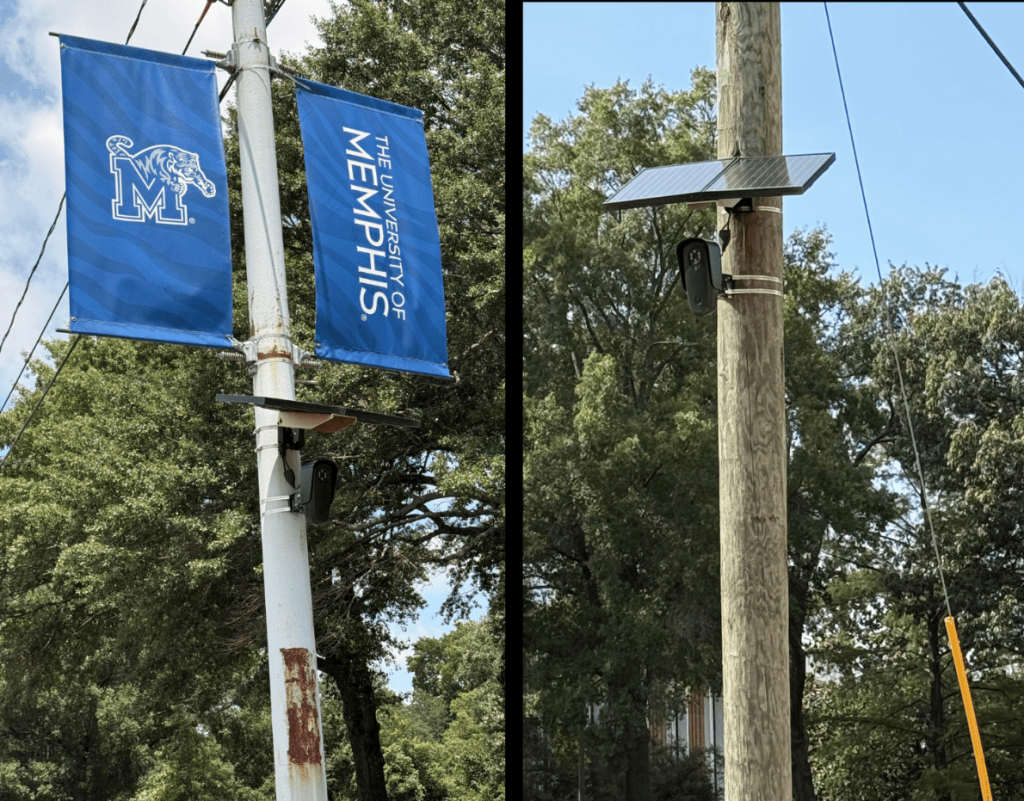
Caption: the left image shows an electricity pole on campus with University of Memphis banners attached on either side and a Flock camera positioned below the banners. The right image shows a Flock camera on the campus border, in front of a parking garage and across the street from off-campus student housing.
“Get the Flock Out”
What do we do about this? While it would, of course, be irresponsible of me to condone the various methods that “Flocked” communities have come up with to battle these devices, I do encourage you to spread the word. Talk to your friends and family members about this, write to your local representatives and district leaders, attend open forum meetings at your universities when implementations like this are being discussed. Students who attend universities that are implementing Flock cameras: speak up. Your tuition dollars are funding this. Reach out to your student senate, your deans, and your campus police departments. The ACLU also has a Get the Flock Out Toolkit, which provides resources for finding ALPRs in your area, sample emails to send to representatives, an ACLU affiliate map, and campaign posters to share. As a last-minute addendum to this blog post, Rep. Tim Burchett of Tennessee recently introduced a bill to the Tennessee House of Representatives called the Protection Against Mass Surveillance Act. If you live in Tennessee, I urge you to contact your representatives and express your support for this bill. If you don’t live in Tennessee, contact your representatives and tell them about this Tennessee bill or about any number of recent contract cancellations or camera deactivations across the US, and call for similar action in your community. In an era where surveillance capitalism has taken root, it is more important now than ever to talk to each other, to band together, and to stay angry but not silent.
Sample Letter Templates for Contacting Your Representatives
- Support for Tennessee’s Protection Against Mass Surveillance Act [link, letter pasted below]
- ACLU’s sample email


Leave a comment